


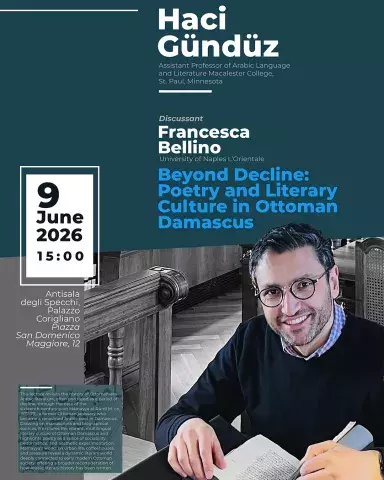
Questa conferenza ripercorre la storia della letteratura araba dell’epoca ottomana, spesso descritta come un periodo di declino, attraverso l’esempio del poeta cinquecentesco Māmayya al-Rūmī (m. 1577–79 circa), un ex-giannizzero ottomano che divenne un rinomato poeta arabo a Damasco. Attingendo a manoscritti e fonti biografiche, la conferenza esplora la vivace cultura letteraria multilingue della Damasco ottomana ed evidenzia la poesia come spazio di interazione sociale, performance e sperimentazione estetica. Le opere di Māmayya sulla vita urbana, i caffè e il piacere rivelano un mondo letterario dinamico profondamente connesso alla società ottomana dell’inizio dell’età moderna, offrendo una più ampia riconsiderazione di come è stata scritta la storia letteraria araba.
For generations, Arabic literary history has often been narrated through the lens of decline (inḥiṭāṭ), with the centuries following the Mongol conquest of Baghdad in 1258 frequently portrayed as a period of stagnation and imitation culminating only with the nineteenth-century nahḍa, or Arab renaissance. Ottoman-era Arabic literature in particular has long occupied a marginal place within both Arabic literary historiography and broader discussions of early modern literary cultures. This lecture revisits that narrative through the case of the sixteenth-century poet Māmayya al-Rūmī (d. ca. 1577–79), a former Ottoman janissary who settled in Damascus and established himself as a celebrated Arabic poet despite his non-Arab background. Drawing on manuscript sources, biographical dictionaries, and literary anthologies, the lecture explores the vibrant literary milieu of Ottoman Damascus and examines how poetry functioned within a multilingual and socially dynamic urban environment. Rather than viewing Ottoman-era Arabic poetry as derivative or stagnant, the lecture argues that it reflected new forms of sociability, patronage, performance, and aesthetic experimentation. Māmayya al-Rūmī’s poetry—ranging from panegyric and occasional verse to poems on coffeehouses, intoxicants, and urban pleasures—reveals a literary culture deeply engaged with the realities of early modern Ottoman society. Through this microhistorical lens, the lecture ultimately proposes a broader reconsideration of how Arabic literary history is written and how literary value is constructed across time.